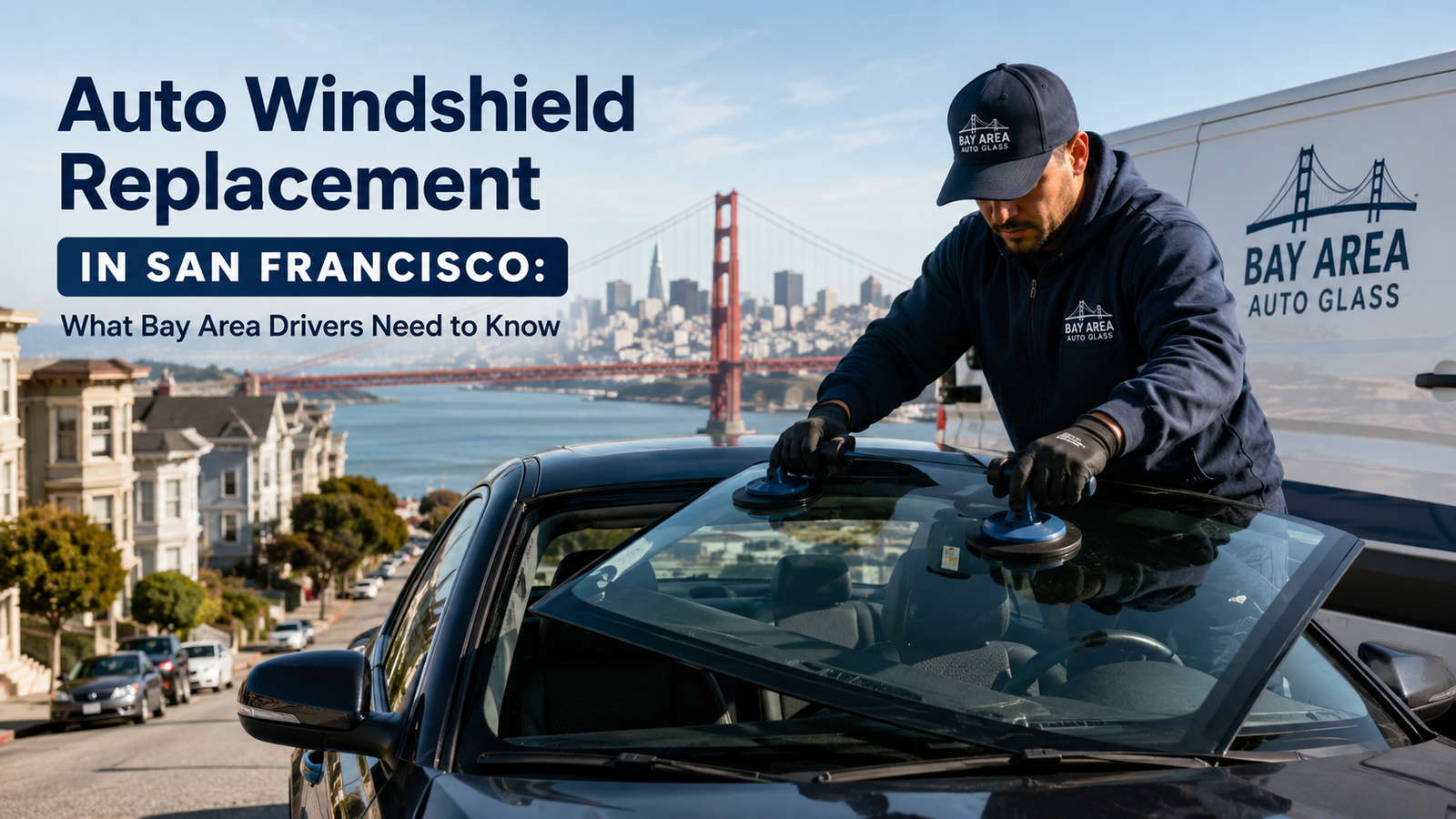

San Francisco drivers face a distinctive set of windshield challenges. The city’s dense urban core, its elevated freeways, the constant presence of construction activity throughout SOMA, the Mission, and the Central Waterfront neighborhoods, and the regular commute traffic through the Bay Bridge and the Golden Gate approaches all create elevated exposure to the road debris and rock chips that damage windshields. When the damage is severe enough to require replacement rather than repair, understanding the Auto Windshield Replacement San Francisco process what it involves, what types of glass are available, and what ADAS recalibration means for your specific vehicle helps San Francisco drivers make informed decisions.
Why San Francisco Conditions Create More Windshield Damage
Urban driving in San Francisco creates higher windshield damage exposure than suburban or rural driving for several compounding reasons. Construction debris is prevalent throughout the city’s ongoing development rock, gravel, aggregate, and construction materials that fall from trucks or are scattered from job sites contribute to road debris that strikes windshields at speed. The stop-and-go traffic that characterizes San Francisco streets means vehicles frequently follow large trucks and buses at close range, where the risk of being struck by debris thrown from large wheels is higher.
Highway 101 through the city, Interstate 80, and the approaches to the Bay Bridge and Golden Gate Bridge involve higher speeds and large truck traffic that generates significant road debris. The dense gravel and stone aggregate used in highway paving and maintenance is a common source of rock chips, particularly in areas where road work has recently been performed. San Francisco’s multiple tunnels the Broadway Tunnel, the Yerba Buena tunnel on the Bay Bridge, and others concentrate traffic in ways that can increase debris exposure from the vehicles ahead.
San Francisco’s weather patterns add another dimension. The combination of cool, damp mornings from bay fog and warm afternoon temperatures creates thermal stress on existing chips and cracks temperature differentials cause existing damage to spread, converting what might have been a repairable chip into a crack that requires replacement.
What Windshield Replacement Involves
Windshield replacement is a multi-step process that goes beyond simply swapping out a piece of glass. The windshield in modern vehicles is a structural component it contributes to the rigidity of the passenger compartment in rollover accidents and serves as the backstop for the front passenger airbag in frontal impacts. Proper replacement ensures these structural functions are preserved.
The replacement process begins with removal of the damaged windshield. The technician carefully cuts through the urethane adhesive bonding the glass to the vehicle body using a cold-knife cutting tool or piano wire, then lifts the old glass from the opening. All remaining adhesive is cleaned from the pinch weld the metal flange that accepts the new glass and the frame is inspected for rust, damage, or other conditions that must be addressed before the new glass is installed.
Primer is applied to the prepared pinch weld to promote adhesion of the new urethane. Fresh urethane adhesive is applied to the pinch weld in a continuous bead, and the new glass is positioned and pressed into place. After installation, the adhesive must cure before the vehicle can be driven most modern fast-cure urethane adhesives achieve safe drive-away time (SDAT) within 30 to 60 minutes, though full cure takes longer.
OEM vs. Aftermarket Glass for San Francisco Vehicles
When a San Francisco driver needs a windshield replaced, they typically have a choice between OEM (Original Equipment Manufacturer) glass and aftermarket glass. OEM glass is produced by or for the vehicle manufacturer to the exact specifications of the original windshield dimensions, optical quality, tint characteristics, acoustic properties, and any special features like heating elements, acoustic interlayers, or sensor mounting zones are matched precisely to the original.
Aftermarket glass is produced by independent manufacturers to fit OEM specifications. Quality varies considerably among aftermarket suppliers premium aftermarket glass from reputable manufacturers can closely match OEM performance, while lower-quality products may have optical distortions, fitment variations, or incompatibilities with vehicle-specific features. For San Francisco drivers with newer vehicles equipped with ADAS cameras, heated windshields, heads-up displays, or acoustic lamination, OEM glass is generally recommended to ensure compatibility with these features.
ADAS Recalibration After Replacement in San Francisco
Many vehicles registered and driven in San Francisco are relatively new the Bay Area’s tech-forward population and high income levels mean that late-model vehicles with extensive ADAS features are prevalent. Lane departure warning, automatic emergency braking, forward collision warning, and adaptive cruise control all frequently rely on a forward-facing camera mounted near the rearview mirror, directly on the windshield. When the windshield is replaced, this camera’s calibration must be verified and, in most cases, reset.
ADAS recalibration after windshield replacement is required for nearly 90 percent of model-year 2023 and newer vehicles. Static calibration is performed in a controlled shop environment using target boards at specified distances. Dynamic calibration involves driving the vehicle under specific conditions while the system self-adjusts. Some vehicles require both. Failure to recalibrate after windshield replacement can cause ADAS systems to generate false warnings, fail to activate when needed, or behave unpredictably creating a genuine safety risk rather than the safety benefit these systems are designed to provide.
Mobile Windshield Replacement in San Francisco
San Francisco’s dense urban geography and parking scarcity make mobile auto glass service particularly valuable. A mobile technician comes to the vehicle’s location whether that is a residential address in the Richmond District, an office building in the Financial District, a parking structure in SOMA, or a parking lot in the Inner Sunset and performs the replacement there. This eliminates the need to drive a cracked windshield across town and navigate San Francisco’s often-congested streets.
Not all mobile installations are appropriate for every vehicle or every situation. Vehicles requiring static ADAS calibration may need a follow-up shop visit for that step, since static calibration requires a controlled indoor environment with precisely positioned targets. Mobile technicians can typically perform the glass installation itself wherever the vehicle is parked and advise on whether a calibration shop visit is also needed.
Frequently Asked Questions About Windshield Replacement in San Francisco
Does California require windshield replacement when the glass is cracked? California Vehicle Code Section 26710 prohibits driving a vehicle with a windshield in a condition that impairs the driver’s view. While this does not mandate replacement for every chip or crack, damage in the driver’s direct line of sight or damage that significantly impairs visibility legally requires attention.
Does my California auto insurance cover windshield replacement? Windshield replacement is typically covered under comprehensive coverage. California does not have a zero-deductible glass law, so your standard comprehensive deductible applies unless you have a specific glass endorsement. Contact your insurer to understand your specific coverage before scheduling service.
How long does windshield replacement take in San Francisco? The installation itself takes 60 to 90 minutes. If ADAS recalibration is required, allow additional time static calibration typically adds 30 to 60 minutes. Mobile service allows the work to be done wherever your vehicle is parked, saving the time of driving to and from a shop.